Introduction
There is a persistent assumption in many organisations that two-way radios are simple devices. Push a button, talk, release. Job done.But the MOTOTRBO R2 delivers a rugged, accessible, and migration-friendly solution for teams moving off legacy analogue systems.The MOTOTRBO R5 steps up to professional mid-tier performance: AI-trained noise suppression, a 32-hour battery, dedicated emergency button, IP67 waterproofing, RFID/NFC connectivity, and full integration into the Motorola Solutions safety and security ecosystem.
This guide is written for the people responsible for making these systems perform: fleet managers sizing and procuring new networks, IT administrators configuring and maintaining them through CPS 2.0, safety officers leveraging emergency automation features
What Digital MOTOTRBO Radios Actually Do
The shift from analogue to MOTOTRBO Digital Mobile Radio (DMR) is not primarily about audio quality — though that improves significantly. It is about what becomes possible when your radio carries purpose-engineered hardware designed for the physical demands of professional environments. Both the R2 and R5 are built to this standard, with meaningful differences in capability tier that match different workforce roles.
The table below provides a direct specification comparison between the R2 and R5 to help you determine the right model for each role in your fleet:
| Specification | MOTOTRBO R2 | MOTOTRBO R5 |
| Tier | Entry-to-mid (migration-friendly) | Professional mid-tier |
| IP Rating | IP55 — dust & water resistant | IP67 — dust-tight & waterproof |
| MIL-STD-810 | 11 environmental conditions | Full MIL-STD-810 compliance |
| Weight | 286g with high-capacity battery | Compact & lightweight |
| Battery Runtime | Full-shift high-density battery | Up to 32 hours (5/5/90 profile) |
| Display | No display — simple knob operation | Bright display: 2 or 3 lines configurable |
| Emergency Button | Programmable buttons (P1/P2) | Dedicated orange emergency button |
| Noise Cancellation | SINC+ with selectable audio profiles | AI-trained SINC+ noise suppression |
| HazLoc | Standard environments | ANSI TIA4950 IS certification available |
| Migration | Drop-in replacement for XiR P3688 users | Step-up from R2; integrates into Motorola ecosystem |
| RFID / NFC | – | Supported for asset tracking & body camera linking |
| IMPRES Battery | IMPRES-compatible batteries | IMPRES battery + charger optimisation; up to 32h runtime |
Durability: Engineered for the Workday, Not the Showroom
MOTOTRBO R2 — IP55, MIL-STD-810, 286g
The R2 carries an IP55 rating, protecting against dust ingress and water jets from any direction — suitable for dusty factories, wet outdoor environments, and the general punishment of an active workday. It meets MIL-STD-810 requirements across 11 environmental conditions, and at just 286g with a high-capacity battery, it is designed to be carried comfortably for an entire shift. Motorola’s Accelerated Life Testing (ALT) programme validated the R2 against simulated 5-year field use conditions before it reached the market.
When an audio accessory is connected, the R2’s dust cover rotates to follow the slim contour of the radio — a small but considered ergonomic detail that signals the level of attention given to real-world usability. The large, curved Push-to-Talk (PTT) button has a generous sweet spot that is quick to locate and activate even when wearing work gloves.
MOTOTRBO R5 — IP67, MIL-STD-810
The R5 steps up to IP67 — fully dust-tight and waterproof to one metre immersion — meeting MIL-STD-810 requirements for drops, vibration, temperature extremes, and humidity. Like the R2, it has undergone Motorola’s ALT programme simulating 5 years of field use. But the R5 also ships standard with five years of software update and hardware repair coverage, protecting the investment and ensuring radios remain current throughout their operational life.
The R5’s controls are designed for maximum usability with minimal training: large rotary volume and channel selector knobs operable with gloves, a tactile PTT button with precise activation feel, programmable shortcut buttons, and a dedicated orange emergency button that is immediately identifiable in any situation.
Audio: Cutting Through Noise in Every Environment
MOTOTRBO R2 — SINC+ and Selectable Audio Profiles
The R2’s SINC+ noise cancellation uses advanced algorithms to isolate and eliminate disruptive background noise on the transmitting side — so colleagues on the receiving end hear a clean voice, not a voice buried in machinery, pneumatic tools, or outdoor ambient noise. On the receiving side, the R2’s selectable audio profiles allow users to amplify low, mid, or high frequencies to match their listening environment and preference, combined with a loud speaker and low distortion design that ensures the message arrives clearly.
For teams spread across large warehouses or open-field operations, the R2 delivers superior range through high receiver sensitivity, high-efficiency antennas, and strong interference immunity — clear audio over long distances even in radio-frequency-congested industrial environments.
MOTOTRBO R5 — AI-Trained Noise Suppression, 106 Phons Output
The R5 takes audio performance a step further with a sophisticated AI-trained noise suppression algorithm. Where the R2’s SINC+ applies signal processing rules, the R5’s embedded software has been trained to distinguish between a human voice and specific categories of background noise — vehicles, crowds, heavy plant machinery — retaining speech while significantly attenuating the noise component. The result is clearer transmitted audio in a wider range of complex acoustic environments.
On the receiving side, the R5’s low-distortion wideband speaker can be set to an extra-loud audio profile delivering up to 106 phons of loudness — measurably audible above very high ambient noise levels. IMPRES technology and Received Audio Levelling smooth out differences in users’ voice levels and microphone placement, while Intelligent Audio continuously adjusts output volume as workers move between quiet offices and noisy production floors.
R5 Connectivity: RFID, NFC, and the Motorola Solutions Ecosystem
integrated RFID and NFC tag support. Fleet managers can use NFC tags to assign a Motorola Solutions VB400 body-worn camera to a specific radio user at the start of a shift — automatically linking video evidence to the radio’s identity in the incident management system — or to automate asset tracking and inventory management workflows without additional handheld scanners.
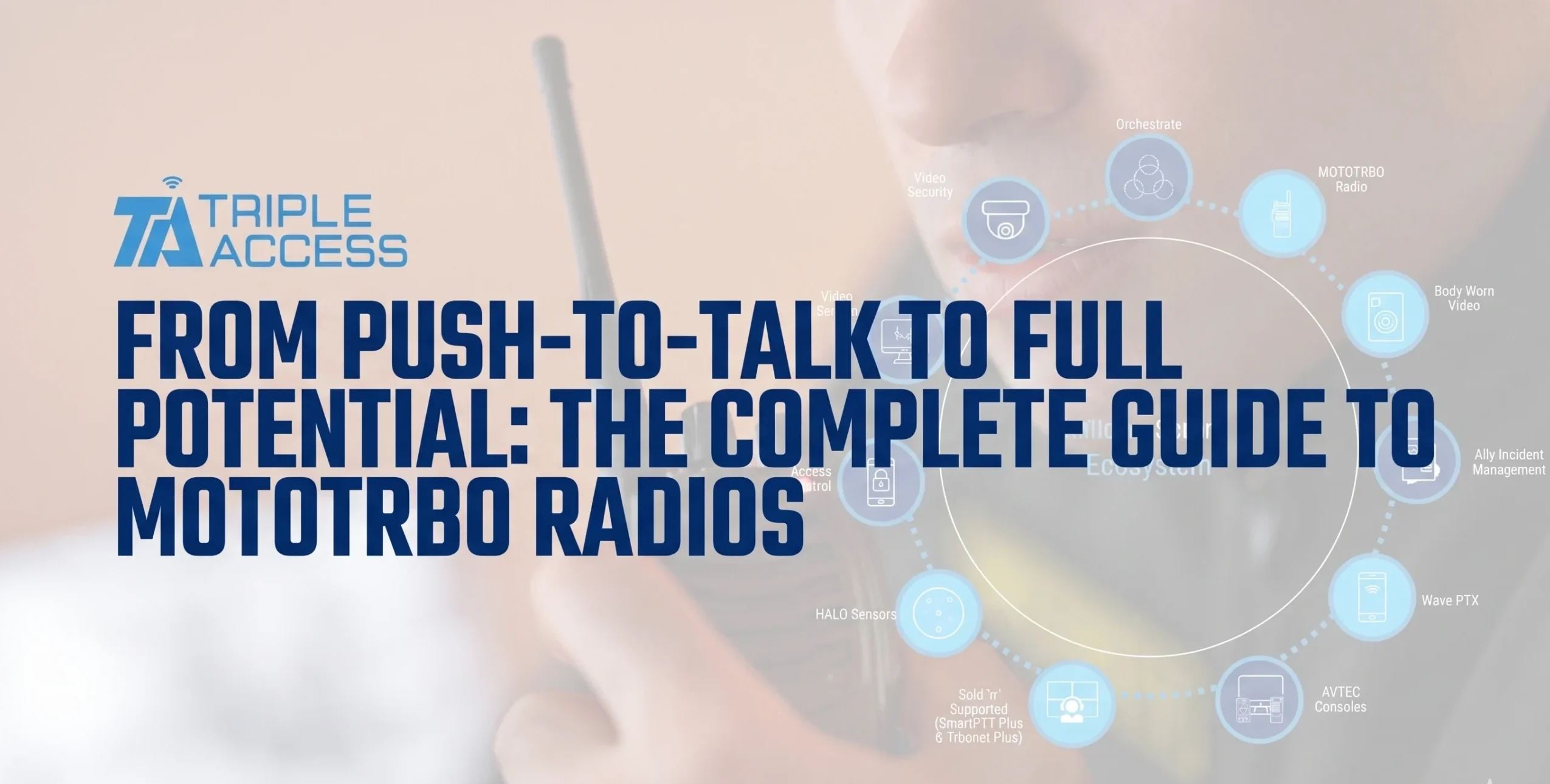
The R5 also integrates directly into the broader Motorola Solutions safety and security ecosystem: receiving automatic alerts from video security and access control systems directly on the device, supporting computer-aided dispatch from a desktop operator console, and extendin
CPS 2.0 and Radio Management
Customer Programming Software 2.0 (CPS 2.0) is the primary tool through which every aspect of MOTOTRBO radio behaviour is configured — channel assignments, talk group memberships, button functions, audio profiles, emergency settings, and dozens of other parameters. For a fleet of any meaningful size, proficiency with CPS 2.0 is not optional. It is the difference between a fleet that performs as designed and one that performs as installed.
The CPS 2.0 Interface: What You Are Actually Configuring
CPS 2.0 organises radio configuration into a hierarchical codeplug — a configuration file that represents every setting for a given radio model. The codeplug is structured around several key areas:
- Zone and channel programming: Zones are logical groupings of channels displayed to the user. A security officer’s radio might have a zone for their shift team’s talk group, a zone for facility-wide emergency channels, and a zone for direct radio-to-radio channels on the floor. Both the R2 and R5 support up to 250 channels and 250 zones on supported configurations.
- Button and function assignment: Every physical and programmable button on the radio can be mapped to a specific function — emergency alarm initiation, talk group scanning on/off, channel access, or priority scan. The R5’s dedicated orange emergency button has a fixed function by design; the R2’s two programmable buttons cover priority scan, pre-programmed text messaging, rental timer, and more.
Smart Energy Management
Battery management is the unsexy reality of radio fleet operations and one of the largest sources of avoidable cost. A fleet without battery intelligence produces charged-looking batteries of unknown actual capacity. Good batteries are condemned alongside degraded ones. Shift completion fails because a radio died at hour six of an eight-hour shift. Both the R2 and R5 address this through IMPRES battery technology — but the R5’s 32-hour runtime represents a step-change in shift coverage for multi-shift operations.
IMPRES Battery Technology: Intelligence at the Cell Level
IMPRES (Integrated Motorola Performance Radio Enhancement System) batteries carry an embedded microprocessor that maintains a continuous record of charge cycle history, depth of discharge, temperature exposure, and predicted remaining capacity — communicating this data to both the radio and to any IMPRES-compatible charger it is placed in.
- Automatic recondition and calibration: An IMPRES charger recognises when a battery’s state-of-charge model has drifted from its actual capacity and automatically initiates a deep discharge-recharge conditioning cycle. This is why IMPRES batteries deliver longer usable life than non-managed equivalents — the calibration happens automatically without any administrator intervention.
- Fleet Management reporting: IMPRES Battery Fleet Management software aggregates health data from every IMPRES battery via the charger network, generating a dashboard showing capacity state, cycle count, conditioning history, and replacement threshold alerts. Maintenance teams replace only batteries that have actually reached end-of-life — not on a fixed calendar schedule.
Accessories: Matching the Hardware to the Environment
R2 Accessories — Purpose-Built for Simplicity and Range
The R2’s accessory range is designed around the same philosophy as the radio itself: straightforward, reliable, and compatible with existing MOTOTRBO infrastructure. The purpose-built Remote Speaker Microphone (RSM) is secured by a robust accessory retainer and lets workers communicate without reaching for their belt — useful in environments where the radio is holstered on a hip or vest. High-efficiency antennas — short, flexible, and redesigned for the R2 — deliver long-distance clarity with high interference immunity.
Emergency Features and Hazardous Location Safety: No Shortcuts
The safety capabilities built into the MOTOTRBO platform are not marketing features. They represent a genuine capability to detect, escalate, and respond to worker emergencies faster than any manual protocol can match. Understanding how these features work, how to configure them correctly, and — critically — the absolute safety rules that govern their use in hazardous environments is a professional obligation for every administrator and safety officer deploying this equipment.
Emergency Button: Immediate Distress Signalling
R5 — Dedicated Orange Emergency Button
The R5 features a dedicated, visually distinctive orange emergency button that triggers an immediate emergency call on the designated emergency channel. The button is intentionally prominent and positioned for single-hand activation — it can be located and pressed instinctively, under stress, in low visibility, or while wearing PPE. When activated, the emergency call transmits the radio’s identity to the dispatch console or control room, enabling immediate location verification and response escalation.
R2 — Programmable Emergency Function
The R2 provides emergency call capability through its programmable button configuration. Administrators assign the emergency call function to one of the R2’s two programmable buttons via CPS 2.0. While the activation method differs from the R5’s dedicated button, the emergency call functionality — immediate transmission on the emergency channel with radio ID notification — is equivalent. The button should be clearly communicated to every R2 user as part of their radio induction.
Lone Worker: Automated Welfare Check
The Lone Worker feature operates on a configurable periodic check-in timer. If the radio detects no user-initiated activity — no PTT press, no button operation, no menu navigation — within the configured interval, it generates a prompt (vibration and tone) requiring the worker to confirm safety by interacting with the radio within a response window. Failure to respond triggers an automatic emergency call. The system functions as an automated welfare check that requires no dispatcher time under normal conditions and escalates autonomously when the worker fails to respond.
HazLoc Compliance: The Rules That Cannot Be Negotiated
Hazardous Locations (HazLoc) are environments where flammable gases, vapours, combustible dusts, or ignitable fibres create potential explosive atmospheres. In these environments, any electrical device represents a potential ignition source if it produces a spark or operates above the ignition temperature of the surrounding atmosphere.
MOTOTRBO R5 — ANSI TIA4950 Intrinsically Safe certification: The R5 is available with ANSI TIA4950 IS certification for use in areas where flammable substances may present fire or explosion hazards. This certification is specific to the radio model, firmware version, and approved accessory combinations. Using an uncertified accessory with a certified radio voids the certification.
MOTOTRBO R2 — Standard environments: The R2’s IP55 and MIL-STD-810 durability is engineered for general industrial environments. For classified HazLoc zones requiring IS certification, the R5 IS variant is the appropriate choice.
Conclusion: Audit, Upgrade, and Future-Proof Your Fleet
A modern MOTOTRBO deployment built around the R2 and R5 is not a radio system in the traditional sense. It is an operational communications ecosystem — one that integrates voice, data, location, safety automation, energy management, and network intelligence into a unified platform managed through CPS 2.0 and the Motorola Solutions service infrastructure.
Triple Access Sdn Bhd stands as a premier Authorized Motorola Solutions Distributor in Malaysia, backed by over 30 years of industry expertise. By offering genuine MOTOTRBO™ hardware.Our commitment to excellence was recently recognized with the Motorola Solutions Empower Circle award, solidifying their reputation as a trusted partner.