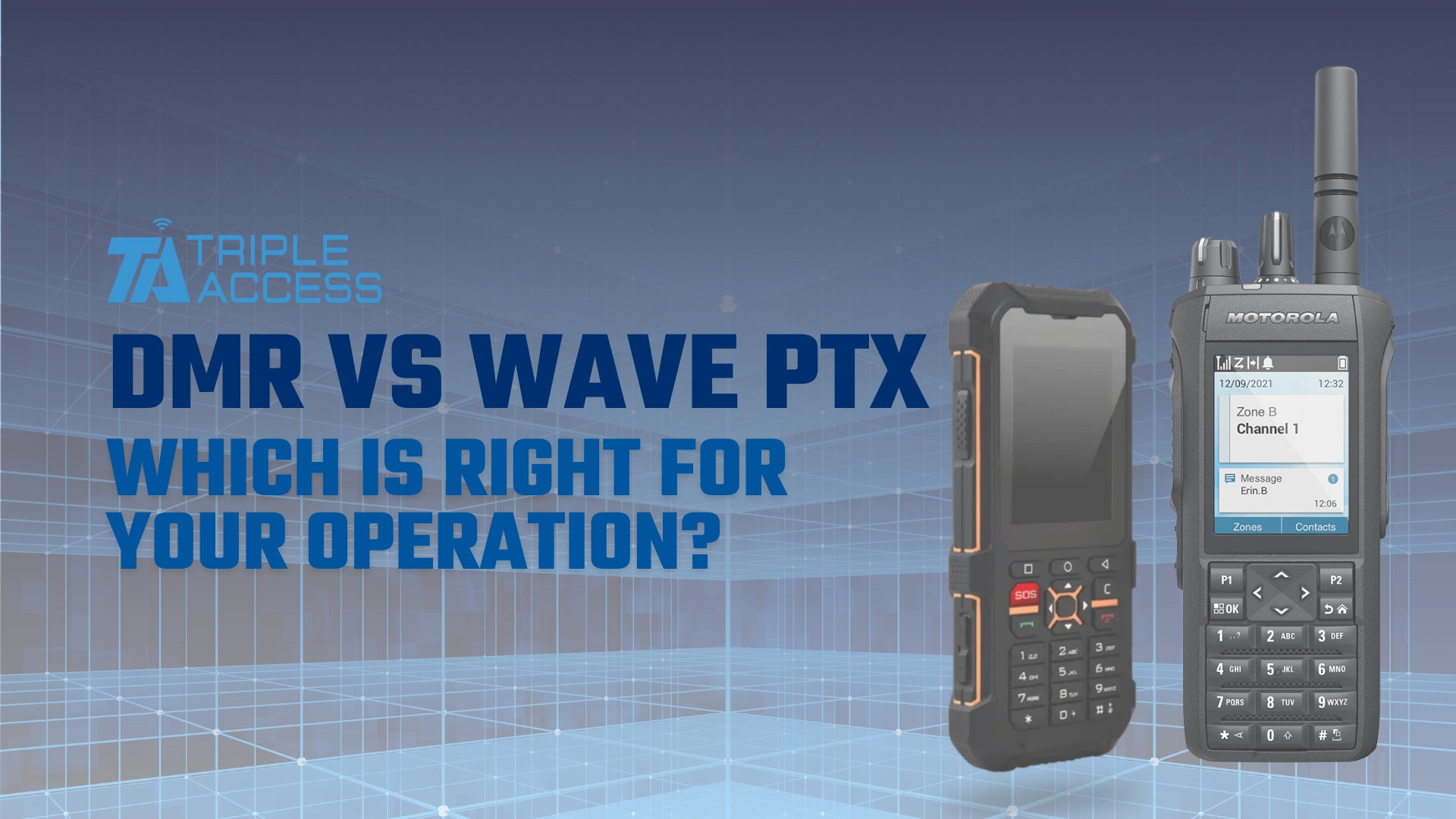
DMR vs WAVE PTX
Which Is Right for Your Operation?
Reliable communication is the backbone of safe and efficient operations. Whether you manage a factory floor, a campus, a security team, or a multi-site business, choosing the right communication technology can directly impact response time, productivity, and safety.
Two of the most common solutions organisations compare today are DMR (Digital Mobile Radio) and WAVE PTX (Push-To-Talk over Broadband). While both enable instant voice communication, they are designed for very different operational needs.
At Triple Access, we work with organizations across education, hospitality, manufacturing, events, logistics, and security. This guide breaks down DMR vs WAVE PTX, explains how each works, and helps you decide which is right for your operation.
What Is DMR (Digital Mobile Radio)?
DMR is a global digital radio standard widely used for professional two-way radio communications. It operates on licensed or unlicensed radio frequencies and does not rely on cellular data or the internet.
DMR radios are commonly used in:
- Manufacturing plants
- Warehouses and logistics hubs
- Security and patrol teams
- Schools, campuses, and hospitals
- Construction sites and facilities management
Key Characteristics of DMR
- Push-to-talk communication with near-zero latency
- Works independently of mobile networks
- Highly reliable in confined or controlled environments
- Supports repeaters for wider coverage
- Designed for mission-critical and safety-focused operations
DMR Communication Solutions

MOTOTRBO™ R2 Portable Radios
Durable digital two-way radios built for everyday operations.

MOTOTRBO™ R7 Series
Next-generation radios with enhanced audio and advanced connectivity

XiR P3688 Radios
Analog/Digital compatibles ideal for easy migration to digital.

XiR M8660i
Scalable professional DMR mobile radios.
What Is WAVE PTX?
WAVE PTX (Push-To-Talk over Broadband) is Motorola Solutions’ cloud-based communication platform. It uses cellular (4G/5G) or Wi-Fi networks to deliver push-to-talk communication across unlimited distances.
WAVE PTX works on:
- Smartphones
- Tablets
- Dedicated broadband PTT devices
- Dispatch consoles
It is commonly adopted by:
- Multi-location organisations
- Event operations teams
- Management and supervisory staff
- Logistics and fleet operations
- Organisations with remote or mobile workforces
Key Characteristics of WAVE PTX
- Nationwide or global coverage (where data is available)
- No radio frequency licensing required
- Integrates voice, text, GPS, and multimedia
- Scales easily without additional radio infrastructure
DMR Communication Solutions

RugGear RG170
Ultra-rugged 4G smart feature phone designed for professional use in extreme safety and working conditions.

Motorola TLK 150
Rugged broadband mobile radio built for in-vehicle use

WAVE PTX Mobile App
Turns smartphones into broadband PTT devices

WAVE PTX Dispatch Console
For coordinated team communication from a central hub
DMR vs WAVE PTX: Core Differences
| Feature | DMR | WAVE PTX |
|---|---|---|
| Network dependency | Independent radio network | Cellular / Wi-Fi data |
| Coverage | Site-based (extendable via repeaters) | Nationwide / global |
| Latency | Extremely low | Slightly higher (data-dependent) |
| Reliability | Very high, predictable | Dependent on data coverage |
| Devices | Two-way radios | Smartphones, PTT devices |
| Infrastructure | Radios, repeaters (if needed) | Cloud-based platform |
| Licensing | RF licensing may apply | No RF licensing |
When DMR Is the Right Choice
DMR is ideal when reliability and instant response are non-negotiable.
Choose DMR if your operation:
- Operates in a single site or controlled area
- Requires communication during emergencies or safety incidents
- Works in basements, factories, or high-interference environments
- Cannot afford downtime due to mobile network failure
- Needs rugged, purpose-built devices for daily use
Typical DMR Use Cases
- Factory incident response
- School or campus security
- Warehouse operations
- Construction site coordination
- Security patrols
At Triple Access, we often recommend DMR for organizations that prioritize operational certainty and compliance.
When WAVE PTX Is the Right Choice
WAVE PTX excels in mobility, scalability, and wide-area communication.
Choose WAVE PTX if your operation:
- Spans multiple locations or cities
- Has teams constantly on the move
- Wants to use existing smartphones
- Requires GPS tracking or multimedia sharing
- Needs fast deployment without radio infrastructure
Typical WAVE PTX Use Cases
- Event management across large venues
- Management and supervisory teams
- Logistics and delivery coordination
- Remote operations and field services
DMR vs WAVE PTX: Cost Considerations
DMR Cost Structure
- Higher upfront hardware cost
- Optional repeater infrastructure
- Long device lifespan (often 5–7 years)
- No recurring data subscription
WAVE PTX Cost Structure
- Lower upfront device cost (if using smartphones)
- Monthly or annual subscription fees
- Dependent on mobile data plans
- Scales quickly with team size
The “cheaper” option depends on how long you plan to use the system and how critical uptime is.
Hybrid Approach: Using DMR and WAVE PTX Together
Many modern organisations do not choose one or the other — they use both.
A hybrid approach allows:
- Frontline teams to use DMR radios for mission-critical communication
- Management to use WAVE PTX for wide-area coordination
- Cross-platform communication between radio and broadband users
At Triple Access, we design hybrid DMR + WAVE PTX solutions that align with real operational workflows.
How Triple Access Helps You Decide
Choosing between DMR and WAVE PTX is not about technology alone — it’s about how your operation actually runs.
Triple Access works closely with customers to:
- Assess operational risks and workflows
- Evaluate coverage and environment constraints
- Design scalable communication architectures
- Ensure regulatory compliance and reliability
We focus on use cases, not product pushing.
Final Verdict: Which Is Right for Your Operation?
- If your priority is maximum reliability, safety, and instant response, DMR is the right choice.
- If your priority is wide-area communication, flexibility, and fast deployment, WAVE PTX is the better fit.
- If you need both — a hybrid solution delivers the best of both worlds.
Talk to Triple Access
Not sure which solution fits your operation?
Speak to Triple Access today to get expert advice on DMR, WAVE PTX, or hybrid communication solutions tailored to your industry.