In today’s world of smartphones, messaging apps, and cloud platforms, many assume traditional radios are outdated.
Yet across shopping malls, stadiums, highways, industrial facilities, and government buildings, one tool remains the backbone of frontline security operations:
The two-way radio.
Why?
Because when safety is on the line, communication cannot fail.
1. Instant Communication — No Dialing, No Delays
Security incidents unfold in seconds.
Mobile phones require:
- Unlocking the device
- Opening an app
- Searching for contacts
- Waiting for connection
Two-way radios eliminate that friction.
With push-to-talk (PTT) communication:
One button.
One channel.
Everyone informed instantly.
During suspicious activity, medical emergencies, access breaches, or perimeter alarms, there is no time for delays. Radios deliver immediate, broadcast communication without hesitation.
2. Built for Group Communication
Security operations are team-based.
Personnel operate across:
- Patrol units
- Command centres
- Access control points
- Parking facilities
- Emergency response teams
Radios are designed for simultaneous group communication, ensuring every member on the channel hears the same message at the same time.
Messaging apps simply cannot replicate the clarity and control of structured talkgroups without confusion, missed alerts, or overlapping messages.
3. Reliability Beyond Consumer Networks
Mobile networks can:
- Experience congestion during major events
- Lose signal in tunnels, basements, or remote areas
- Suffer unexpected outages
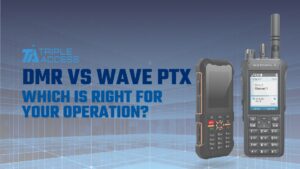
Professional two-way radio systems — including Digital Mobile Radio (DMR) and Push-to-Talk over Cellular (PoC) solutions like Motorola WAVE PTX — are engineered for:
- Wide-area coverage
- High system availability
- Operational-grade reliability
In mission-critical environments, security teams cannot depend solely on consumer-grade communication tools.
4. Designed for Tough Operational Environments
Security personnel work in environments that are:
- Hot
- Wet
- Dusty
- Loud
- Physically demanding
Professional radios are purpose-built with:
- Rugged, drop-resistant casing
- IP-rated water and dust protection
- Loud, clear audio output
- Glove-friendly buttons
- Long battery life for full shifts
Smartphones are not engineered for this level of durability.
5. Structured and Controlled Communication
Security communication must be organised — not chaotic.
Unlike casual messaging groups, professional radio systems provide:
- Dedicated talkgroups
- Role-based communication
- Supervisor oversight
- Centralised dispatch consoles
- Call recording and playback (where applicable)
This ensures:
- No message clutter
- No irrelevant conversations
- Clear communication hierarchy
- Accountability across teams
Structure is critical when managing incidents across multiple departments.
6. Clear Audio in Noisy Environments
Security teams operate in noisy environments such as:
- Shopping malls
- Concert venues
- Highways
- Industrial sites
- Stadiums
Professional digital radios offer:
- Advanced noise suppression
- Enhanced speaker output
- Clear digital audio quality
When directing crowd control or responding to an emergency, clarity saves time — and potentially lives.
7. Real-Time Visibility with GPS & Dispatch
Modern communication solutions go far beyond voice.
Solutions such as Motorola WAVE PTX enable:
- GPS tracking of patrol teams
- Real-time location visibility
- Centralised dispatch monitoring
- Multi-site coordination
Supervisors can instantly see where personnel are deployed, improving accountability, response time, and operational oversight.
Communication becomes not just faster — but smarter.
8. Accountability with Integrated Body-Worn Cameras
Security operations increasingly require transparency and documentation.
When integrated with body-worn cameras, communication systems can enhance:
- Incident documentation
- Post-incident review
- Training improvements
- Professional accountability
Voice coordination combined with visual evidence creates a comprehensive security ecosystem — voice plus visibility.
9. Faster, Coordinated Emergency Response
Security teams are often the first responders to:
- Fire alarms
- Medical emergencies
- Suspicious packages
- Access breaches
- Traffic incidents
Two-way radios allow:
- Immediate broadcast alerts
- Instant coordination with command
- Simultaneous communication across departments
No buffering.
No typing.
No waiting.
Just clear, immediate action.
10. A Proven Technology That Continues to Evolve
Two-way radios have supported mission-critical operations for decades — and they continue to advance.
Today’s systems combine:
- Digital clarity (DMR)
- Push-to-talk over cellular (PoC)
- 4G/5G nationwide coverage
- Cloud-based dispatch consoles
- GPS tracking
- Integrated video support
Security teams are not resistant to innovation.
They simply rely on tools that are built to perform when it matters most.
And radios work.
The Bottom Line
Security teams continue to rely on two-way radios because they are:
- Instant
- Reliable
- Structured
- Durable
- Purpose-built for operational environments
While smartphones are powerful communication tools, mission-critical security operations demand purpose-built solutions designed for performance, not convenience.
How Triple Access Supports Modern Security Operations
At Triple Access, we help organisations design and implement professional communication systems tailored to their operational needs.
Our solutions include:
- Digital Mobile Radio (DMR) systems
- Motorola WAVE PTX nationwide communication
- Dispatch console setup and integration
- GPS tracking and monitoring
- Body-worn camera solutions
- System design, deployment, and ongoing support
We don’t just supply devices.
We design integrated communication ecosystems that improve coordination, safety, and operational efficiency.
Looking to Upgrade Your Security Communication System?
Contact Triple Access today to explore how modern radio and push-to-talk solutions can enhance your team’s performance and response capabilities.
When every second matters, communication must perform.